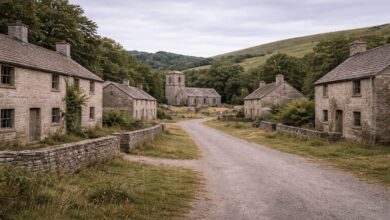
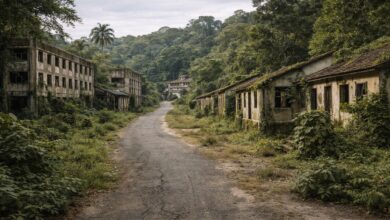
Along Grasshopper Creek in southwestern Montana, the abandoned settlement of Bannack, Montana stands as a frontier town that never softened with time. Founded in 1862 after the discovery of gold, Bannack rose with remarkable speed. Buildings appeared quickly. Authority was declared before it was secured. Opportunity arrived hand in hand with danger. The town’s brief prosperity concealed a constant tension that shaped daily life and defined how it ended.
What remains today is not simply an abandoned mining town, but a place where urgency, fear, and sudden endings became embedded in wood, layout, and silence. Bannack does not feel forgotten. It feels paused.
What endures is restraint rather than decay.
A town formed under pressure
Bannack was established during a period when gold discoveries dictated settlement more than geography or comfort. Location followed extraction, not safety. Within months, saloons, hotels, stores, and homes filled the creekside valley. Bannack even became the first territorial capital of Montana, a designation that suggested order in a place still governed by distance and uncertainty.
The town existed entirely to serve mining. Housing, power generation, processing mills, and transport systems formed a tightly integrated system. Similar human responses to isolation and environmental pressure appear in the settlement of Silver City, where abandonment preserved structure but erased function.
Gold and fragile authority
Gold drew people quickly, but few intended to stay. The population shifted constantly as miners, traders, and travelers moved through the town. Formal law existed, yet enforcement was inconsistent and often overwhelmed by circumstance.
Authority relied heavily on perception. When confidence in leadership weakened, fear stepped in. Justice became situational rather than procedural. Bannack’s reputation for violence emerged from this imbalance, where control felt necessary and restraint felt risky.
Instability did not arrive suddenly. It was present from the start.
Violence as a structural condition
Historical records describe Bannack as a place where conflict was common and resolution was often final. Murders, robberies, and disappearances shaped how residents understood safety. Vigilante action emerged not as spectacle, but as response.
Violence became part of the town’s operating logic. Decisions were compressed. Outcomes were immediate. In Bannack, survival often depended on acting before certainty could form.
That pattern left marks that outlasted the population.
Architecture shaped by urgency
Bannack’s buildings were constructed quickly, using locally available materials and straightforward methods. Function outweighed refinement. Interiors are narrow. Walls feel close. Windows face outward with practical intent.
The courthouse, jail, and gallows stand within short distance of one another, a physical reminder of how rapidly daily life could transition into confinement or execution. These structures do not dramatize history. They preserve it through proximity and proportion.
The town’s layout communicates caution.
A town that ended without transition
Unlike settlements that faded gradually, Bannack emptied abruptly. When richer gold strikes were discovered elsewhere, residents departed in waves. Businesses closed. Homes were left furnished. Purpose disappeared faster than structures could adapt.
There was no ceremony of decline. The town did not prepare for absence. It simply stopped.
This interruption defines Bannack’s present atmosphere.
Silence that feels deliberate
Bannack’s quiet does not feel peaceful. It feels intentional. Buildings stand intact enough to suggest return, yet no return followed. Objects remain in place because departure was swift, not because preservation was planned.
Silence here feels held rather than empty. The town appears aware of what it lost.
Why Bannack still resonates
Bannack continues to matter because it demonstrates how instability imprints itself onto place. It shows how communities built around speed and extraction struggle to sustain cohesion once urgency disappears.
The town does not depend on legend to communicate its past. Evidence remains visible in structure, spacing, and absence. Bannack explains itself without narration.
It is not mysterious. It is precise.
A frontier lesson preserved
Bannack stands as a physical record of ambition exceeding stability. Its buildings reflect decisions made under pressure and authority exercised without certainty. What remains is not nostalgia, but consequence.
The town endures because its tension was never resolved.
Enduring Perspective
Bannack endures as a frontier town where violence, urgency, and sudden endings shaped both community and space. Its silence is not empty. It is structured by history, preserved through interruption rather than decay. In Bannack, absence does not soften memory. It holds it in place. Related reflections on memory and perception can also be found in Tak Tak Schoolhouse.
Horizon Report documents places shaped by memory, infrastructure, and human decisions. Our editorial approach focuses on what remains physically visible, how abandonment unfolds over time, and how interpretation is clearly separated from observable evidence.
For readers seeking deeper context, the following background articles explore how ghost towns emerge, why communities are left behind, and why preservation matters in understanding collective history.
- Abandonment And Ghost Towns
- What Is A Ghost Town
- Why Towns Are Abandoned
- Preserving Abandoned Places
Editorial transparency matters. Observations are grounded in site layout, materials, remaining structures, and documented timelines where available. Interpretive layers are presented as interpretation, not assertion.
Careful readers often notice details worth refining. Thoughtful feedback helps ensure accuracy, clarity, and long term editorial integrity.